Wednesday, August 16, 2017

BOTAL GALI (THE FADING BAZAR)


BOTAL GALI
THE FADING BAZAR


It was a working day early in the morning when I accompanied my driver in Karachi to go to BOTAL GALI (Bottle Lane) as my previous attempts to enter into this congested and narrow lane proved to be an exercise in futility because I committed the common mistake of accessing this lane during the peak rush hours in the afternoon previously.


It was about 9.00 am the traffic was light and I made my way from D.H.A. Karachi to Bander road. Here again I had to make a double left turn to Hassan Ali Effendi road and crossed Pakistan Chowk to reach BOTAL GALI.

BOTAL GALI at the time of partition was called PARSI GALI as most of the residents at that time were PARSI’s having migrated from India and even some people of British origin also had their residences there.

The street gradually transformed from a thriving residential district to a commercial one, featuring shops selling all kinds of bottles — perfumes, medicines, beverages, you name it.
 
Later on it was termed as BOTAL GALI because all sorts of bottles whether in glass, ceramic, brass, plastic, pewter and leather could be sold and purchased here. The real fascination of this GALI is that you can find all sorts of fancy, psychedelic empty liquor bottles which have been cleaned and purified for future consumption.
  
BOTAL GALI stands out as a mix of architecture having survived centuries old wear and tear and beyond expectations it gives a very fascinating appeal from a distance but as you come near it and enter the GALI you find surviving blocks of apartments and shops here and there that are in sharp contrast with the monumental ugliness of recent horrendous cement construction which has taken around this place.
 
Now a day’s BOTAL GALI also is a home for a lot of perfume vendors and their shops glow with the full glitter of the energy savers that are used excessively to highlight and portray the numerous types of perfume bottles which signifies that this business of perfume is better as compared to their neighbors who are selling empty bottles.

In Pakistan there are certain names which click to the mind as if those things are in abundance there but the names are a misnomer as you do not find monkeys on Bandar road, no boat in the boat basin and no female cobra snakes in the NAGIN CHOWRANGI but in BOTAL GALI you do find bottles of all sorts. 
 
BOTAL GALI is surrounded by colonial style buildings which have many stories to tell dating back to pre-partition times and it seems  that this place lives more in the past than in the present and it is more of what it was and not what it is now. 

The old residents of BOTAL GALI have slowly faded out along with the colonial style buildings which have fell in to partial ruins and decrepitude probably because of disrepair, neglect apathy and up keep by the lack of sense of ownership of the residents but two important factors are also an aggravating and catalytic for the present dismal state of affairs and responsible for the slow death of BOTAL GALI the first being the excessive sale of plastic bottles and secondly the increasing crime wave in Karachi.
 
The residents of BOTAL GALI are so akin and used to the common “Robberies, holdup and snatching that they take it as a part of their daily routine. 
The irony of fate is that BOTAL GALI could have been preserved as a symbol of national heritage and reverence to our shared past colonial rule and but it seems that BOTAL GALI has been left to fend for itself against all these odds, as the insecure residents and shop keepers have very little resistance to offer and remain there more for their emotional attachment rather than for the business that they are pursuing. 

The emotional attachment that the people of the street feel for it is evident in their determination to stick to it, no matter what. It’s almost like they are living in the past as if today doesn’t matter.
Of course there are the national problems of load shedding and water supply which makes the place unfriendly and inhospitable to the new comers despite the fact that this is the problem of the whole country.
BOTAL GALI is a collectors delight where you can find a variety of colorful and beautifully carved bottles available in a range of sizes. The most common ones are the plastic and glass ones, especially the smaller palm-sized bottles used by the local perfume and ITTAR industry. 

Of course, many bottles found here are also used solely for decoration purposes. I visited one shop where the shop keeper showed me unique glass bottle and vases which he claimed are more than a century old and has been handed down to him from one generation to another. I jokingly asked him about the price of this decorative long bottle but he proudly shrugged his shoulders and said that these bottles are family heritage and not for sale.
 
The general impression about the shopkeepers of BOTAL GALI is that they are rude and arrogant but what is really interesting is the stories they have to tell some of which date back to the pre-partition times. 

BOTAL GALI is like a small island demarcated by old high rise buildings but it is just a street which has an amalgamation of the past and present, from genie style mysterious colored glass bottles to the present bulk produced plastic bottles where you can see people buying and selling and interacting with one another.

There are certain nooks and corners of BOTAL GALI which give a mysterious look as they do not appear as they used to be, by that I mean closed shops and blank walls which are just used as a support of dump trash. Motorcycles are parked haphazardly in the GALI which makes the flow of traffic and pedestrians difficult causing parking problems which is a nuisance for the shop keepers who by virtue of shared  emotional attachment are sticking to their shops despite the fact that the business in now going downhill.
This is a wakeup call for all the students of fine arts and volunteers who believe in fine artistic values to come forward redesign these shops hand paint these old bottles so that they can be sold at a premium and the money recycled back for the face lift of BOTAL GALI which is much needed otherwise it will sink into oblivion. 

I appeal to the governor of SINDH along with the minister of Tourism SINDH to kindly allocate some funds for the rehabilitation and refurbishing of this BOTAL GALI so that it can be preserved as a National Icon for posterity and succeeding generations.
 
Dr. Babur Zahiruddin


TOWER OF SILENCE


TOWER OF SILENCE


As a Master Trainer in Human Resources, I always put MCQ questions to my participants about the various ecological and geographical sites of Pakistan and my favorite question is “Where is the TOWER OF SILENCE located in Pakistan”?

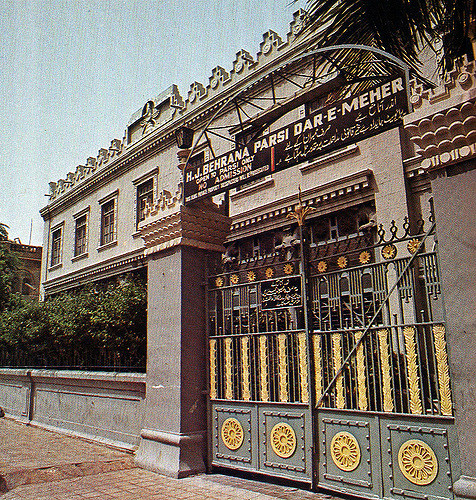
It was the morning of 14th December 2016, at 9.00 am, I was waiting at the entry gate to the PARSI Colony located near KALA PULL (Black Bridge) in Mehmoodabad Karachi and waited for my escort to take me inside for a guided tour of the PARSI Colony Karachi.

The PARSI’s are a very close knit secluded community who pride themselves in their religious norms, customs and traditions which they have practiced for times immemorial.
Hence the entry into the closely guarded walled PARSI colony is restricted and you can only enter if you have some PARSI friend escorting you and in this case it was one of my old Army contacts who arrived on time and took me inside the colony.
My objective today was to see the Tower of Silence in the PARSI Colony which had always intrigued me and was like an obsession for me to visit and write about this secluded, mysterious, cryptic, esoteric forbidden area. 

My escort took me up to the funeral pier and told me that beyond this point even he cannot go as the ritual precinct can only be entered by a special class of pallbearers, called nusessalars, a contraction of nasa.salar, caretaker (-salar) of potential pollutants (nasa-).
A TOWER OF SILENCE is a circular, raised structure built by PARSI’s (Zoroastrians) for excarnation – that is, for dead bodies to be exposed to carrion birds.
Carrion birds are large, carnivorous, scavenger birds, species include buzzards, rocs, condors, vultures, and swoops. They usually have featherless heads and broad, slow-flapping wingspans. 

The Zoroastrians faith and rationale is that the earth and fire are considered sacred and should not be exposed to contamination. Zoroastrian tradition considers a dead body (in addition to cut hair and nail parings) to be nasu, unclean, i.e. potential pollutants.
One of the earliest literary descriptions of such a building appears in the late 9th-century Epistles of Manushchihr, where the technical term is astodan, "ossuary".  Ossuary a container or room in which the bones of dead people are placed. Another term used is dokhmag, for any place for the dead. 

In the Indo Pak sub continent the first tower of silence was built in Doongerwadi Mumbai and hence bears the same name as it was constructed on a hill of that name.
The modern-day towers, which are fairly uniform in their construction, have an almost flat roof, with the perimeter being slightly higher than the center so that the remains slide down easily.
The roof is divided into three concentric rings: the bodies of men are arranged around the outer ring, women in the second circle, and children in the innermost ring. 

The bodies are then left for the Vultures to dispose off and no other method has proved fully effective.
Once the bones have been bleached by the sun and wind, which can take as long as a year, they are collected in an ossuary pit at the center of the tower, where – assisted by lime – they gradually disintegrate, and the remaining material – with run-off rainwater or the underlying sea takes care of the rest.  
If you look at the old map of Karachi the sea had access right up to Mahmoodabad, Baradari, and Abdullah Shah Ghazi Mazaar, but later on with the passage of time the sea receded leaving behind the sandy beaches of Clifton and sea view.

As I was taking photographs of the tower I could not help noticing that there were no carrion birds in the vicinity and only a few stray eagles  and kites perched themselves above the Tower walls.
The reasons for this is  the population of birds of prey in the Indian subcontinent has declined nearly 100% due to DICLOFENAC poisoning of the birds following the introduction of that drug for livestock in the 1990. 

The few surviving birds are often unable to fully consume the bodies. PARSI communities in India are currently evaluating captive breeding of vultures and the use of "solar concentrators" to accelerate decomposition. Some have been forced to resort to burial, as the solar collectors work only in clear weather. 

The PARSI community in Pakistan are concentrated mostly in the city of Karachi and have made quite a remarkable impact on the metropolis, but the size of the always small PARSI community in Karachi is on the decline.


The major reason for the declining population of PARSI’s in Karachi is migration to Western countries.
There are about 1200 to 1300 PARSI’S in Pakistan according to a local census done privately and the attrition rate is further declining due to the senility of the PARSI population and low reproductive rate just like the drop in the ocean of a city.
In recent years, the PARSI’s motivation to leave Pakistan has been compounded by the extremely volatile political and security conditions, a sentiment reflected among both the young and old in the community.

The contribution of the PARSI’s in charitable, philanthropic and altruistic activities like, school, dispensaries, play grounds, hospitals and welfare centres without discrimination of religion has to be applauded and placed on record.

 
PARSI’s are sometimes referred to as "fire-worshippers" because of the central role that fire plays in their rituals. Their temples each have a consecrated fire that burns eternally and some of the fires have been kept alive for centuries.
The priests Nawar wear masks covering their mouths and noses so that the fire is not desecrated by their breath or saliva.

More than half the PARSI population in Karachi now is over fifty years old. The local clergy MOBED
also called DASTURJI is aging, without anyone to replace them.

It is very difficult to get hold of trained Nawar as they are schooled in India, and are in no mood to move to Pakistan "for all the money in the world."
"At our fire temple, we have three priests. Two of them are more than 80 years old," says Shahveer Byramji, Zane Byramji's uncle and a managing trustee of one of the two fire temples in the city.

 
I stood at the funeral pier and glanced around I was wonder stuck with many tablets, plaques and inscriptions which were written on the structures around the tower of silence and notable of them was
UNEQUAL IN LIFE, ALL LIE EQUAL IN DEATH.

But there was more written on that marble slab, in letters accentuated with black ink: NO SPECIAL PLACE FOR ANYONE. NO MINE, NO THINE, NO HIS, NO HERS, ALL INSEPARABLE AND INDISTINGUISHABLE, SLEEP SIDE BY SIDE, PARTNERS AND EQUALS.

It is the perception belief and interpretation of one’s religious norms which separates us from one another where as GOD created all human beings equal to one another. 

As I made my way back to the entrance I ruminated deeply that no religion of the world promotes violence but teaches us to live in peace, harmony and to love our fellow human beings.
I hope my message of religious harmony spreads to all corners of the world.   

Dr. Babur Zahiruddin


PRINCES OF HOPE


PRINCES OF HOPE


I have traveled across the length and breadth of Pakistan, from the KHUNJERAB pass to the desolate areas of BALOCHISTAN from the BROGHIL pass near the WAKHAN Corridor to the vast sandy beaches of MAKRAN.


The more I travel across the beautiful regions of PAKISTAN, the more I realize how little I know about the vast expanse of the beautiful wilderness, breath taking scenery and eye catching views that exist in abundance, just waiting to be explored.


This time my training assignments took me to Karachi from where over the weekend I made a programme to visit HINGOL NATIONAL PARK. 


As I was making this programme for Baluchistan many people discouraged me from going there citing reasons of law and order situation and the hostility of the local population.


The reason for this caution and fear is obvious as the area beyond coastal highway in Baluchistan does not feature well in the news. Secondly the MAKRAN Coastal highway is located quite far away from the centre of Karachi and at a distance of 250 km and a five hours drive. 


I brushed aside all these apprehensions and worries and made a firm resolve and determination to visit HINGOL NATIONAL PARK and pay my respects to PRINCES OF HOPE.


It was early Sunday morning when I replied to the call of the Moazzin after that I got dressed, had my breakfast in the PNS KARSAZ Mess and waited for my driver to come and pick me up which he did at about 7:00 am.


The morning traffic was light and I made my way across the empty streets of Karachi. I opened my car windows to sniff the aromatic aroma of the early October cool breeze coming from the sea caressing me like a damsel stresses across my cheeks.


My driving took me to the national highway N-25, which can be accessed from HUB in LASBELA district near KARACHI which is the border belt between SINDH and BALUCHISTAN. Crossing HUB you go past the GADANI beach which is famous for its ship breaking industry and you can also go to WANDER and SOMIANI beaches. 


The MAKRAN Coastal Highway starts about 10 kms short of a place called UTHAL a city of LASBELA district with a clear blue sign indicating the direction. 


While N-25 continues due north, the MAKRAN Coastal Highway branches off towards west (left). Much before the village of SANGAL, you will find dirt track leading to CHANDARGUP towards your left. CHANDARGUP is the highest mud volcano in the area and revered by the Hindu’s for their pilgrimage. 


Another important place to visit is a Hindu temple called NANI MANDIR (HINGLAG MATA), which is off the main highway by 6 kms. In order to visit NANI MANDIR you must have a good sturdy 4x4 vehicle as normal cars cannot reach this MANDIR because of the bad road condition. NANI MANDIR is an important Hindu pilgrimage site. The visit or the pilgrimage to this site is also called ‘NANI KA HAJ’.
 

Continuing my journey on the MARAKN Coastal Highway after crossing the HINGOL River, I reached the KUND MALIR Beach. From here the coastal highway moves directly up north entering into the BUZI Pass. Flanked by the mud-mountains, the road starts to turn towards west (left). From here one would first come across the Sphinx and then the PRINCESS OF HOPE.
 

Going further west, the road started to descend towards RUDENI BAND and would finally lead to the ORMARA seaport. The same road continues west towards GWADAR, but that is a long drive ahead. For a day’s journey, one should not go beyond ORMARA, unless arrangements for night stay at ORMARA are made in advance.


All of you must have heard about the beaches of Thailand and Caribbean, but let me assure you that the beaches of MAKRAN Coastal highway are far more fascinating and beautiful than the ones mentioned above. 

These are pristine crystal clear blue water beaches which are in isolation and wilderness and no inhabitation is visible for miles and miles expect for a few fishing villages. 


Furthermore, I found that BALOCHIS, like all Pakistanis are very hospitable by nature. I did not encounter many people on my way to the KUND MALIR beach. On the beach itself, I met many fishermen who were extremely friendly and generously offered me some of their catch which I politely declined.


The PRINCESS OF HOPE is a mud carved naturally occurring statue like structure which bears resemblance to the silhouette of a standing woman. It is found in the HINGOL NATIONAL PARK area and lies on the MAKRAN coastal highway in Baluchistan. The name PRINCESS OF HOPE was given to this structure by Hollywood actress ANGELINA JOLIE on her visit to this area while acting as the UN Ambassador of Goodwill in 2002. 


The coast of MAKRAN has muddy hills with very fast moving winds blowing throughout the year. These fast winds cut through the muddy hills and mountains and can result in a natural rock formations shaped like a standing lady (PRINCESS OF HOPE) or sphinx.


The huge man made Sphinx in Giza, Egypt is viewed by countless tourists from across the globe with awe and praise for those who made it. But there is one natural feature in the remote area of the Makran coastal region of the Balochistan province of Pakistan that resembles much the same as the Egyptian Sphinx and is worth a visit.


Other than the amazingly smooth road, the MAKRAN Coastal Highway bears stunning natural rock formations on both sides and it’s a pleasure to watch these as you drive past.

For those who have seen the American Grand Canyon and the Egyptian Pyramids, you can form a rosy sketch in your mind and compare it with the Makran Coastal Highway beautiful scenery.


A stainless carpet-like road surrounded by mountains with camels sauntering on both sides of the track, the MAKRAN Coastal Highway is sheer joy to drive on. It is not difficult to forget that you’re just a couple of hours away from Karachi. The freshness of air, ozone filled environment, creates the setting for a long enjoyable drive which remains fresh in your memory for times to come.


It is recommended that since the journey is quite long and there are no shops / Khokha after Zero Point (at the start of the Makran Coastal Highway), you should plan your journey in advance be well-equipped with all necessary arrangements specially food, snacks, waters and have your vehicle tank topped up at HUB.


Another peculiar feature of this area is that mobile signals fade out as soon as you reach Zero Point so make a brief stopover at UTHAL and make your necessary calls before leaving that area.

So next time you are in Karachi for business or pleasure make sure to visit  HINGOL NATIONAL PARK and pay your respects to the PRINCES OF HOPE on the MAKRAN Coastal Highway.


Dr. Babur Zahiruddin.